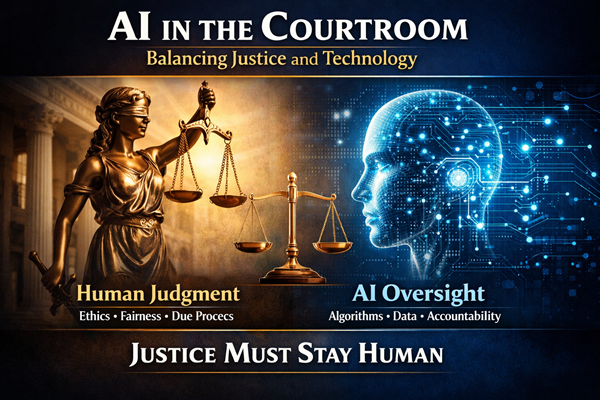
Artificial Intelligence, the Courtroom, and the Future of Justice: What Will Change, What Won’t, and How the Justice System Is Responding
Artificial intelligence (AI) is rapidly reshaping nearly every sector of society, from healthcare and education to finance and transportation. As these technologies mature, an unavoidable question has emerged: What happens when AI enters the courtroom? More specifically, how will AI affect jury selection, courtroom proceedings, attorneys, judges, and the administration of justice itself?
The legal system occupies a unique position in society. Courts do not merely process information or optimize outcomes; they are tasked with administering justice, protecting constitutional rights, and reflecting community values. Because of this, AI cannot be adopted in law the same way it is in business or technology. Instead, it must be handled carefully, transparently, and within strict legal and ethical boundaries.
This article examines how AI is currently being used in the legal system, how it may be used in the future — particularly in courtrooms and jury selection — and why it is unlikely to replace human juries, attorneys, or judges. Most importantly, it explains how courts and justice departments are likely to regulate and limit AI to preserve fairness, due process, and human accountability.
The Foundational Principle: Justice Must Remain Human
At the core of the American legal system is a principle that predates computers, algorithms, and automation: justice is a human responsibility. Jury trials, judicial discretion, and legal advocacy are grounded in moral reasoning, empathy, and community judgment — qualities that cannot be reduced to data points.
The right to a trial by an impartial jury is protected by the Sixth Amendment, and the right to due process and equal protection under the law is guaranteed by the Fifth Amendment and Fourteenth Amendment. These protections assume human decision-makers who can be questioned, challenged, and held accountable.
As AI enters legal spaces, courts must ensure that these constitutional guarantees are not weakened by opaque systems or automated decision-making.
How AI Is Already Used in the Legal System
AI is not new to law. For over a decade, courts and legal professionals have used software tools that rely on machine learning and automation. However, most of these tools operate outside the courtroom or in a strictly supportive role.
Current uses include:
- Legal research platforms that scan case law and statutes
- Document review tools used in discovery
- Scheduling and docket management systems
- Transcription and court reporting software
- Predictive tools used by attorneys to assess litigation risk
These applications are largely administrative or analytical. They assist humans but do not make binding legal decisions.
The U.S. Department of Justice and state court systems have consistently emphasized that AI tools must remain advisory and must not replace judicial authority or jury deliberation.
AI and the Courtroom: What It Can and Cannot Do
The courtroom is where legal authority is exercised most visibly. It is also where AI faces its strongest limits.
What AI May Be Used For
In courtroom settings, AI may assist with:
- Organizing large volumes of evidence
- Highlighting inconsistencies in documents
- Providing real-time transcription and translation
- Helping judges manage complex dockets
- Supporting accessibility for people with disabilities
In these roles, AI functions as a tool — similar to legal software or electronic filing systems — rather than as a decision-maker.
What AI Cannot Do
AI cannot:
- Determine guilt or innocence
- Replace jury deliberation
- Assess witness credibility
- Weigh moral responsibility
- Issue verdicts or sentences
Courts have repeatedly emphasized that judgment, not computation, is the heart of justice. Algorithms cannot experience doubt, remorse, compassion, or moral reasoning — elements that are essential in criminal and civil trials.
Jury Selection and AI: Assistance, Not Control
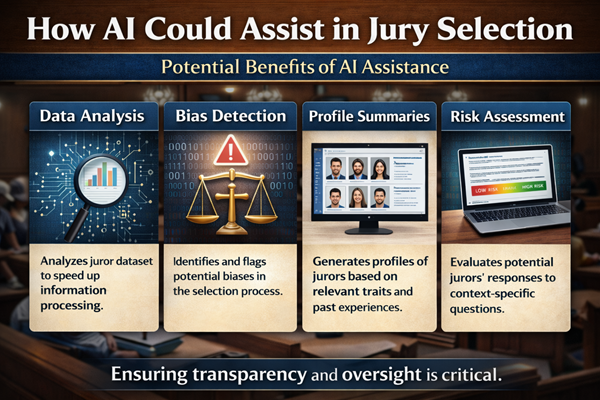
Jury selection is one of the most sensitive areas where AI may be introduced. The goal of jury selection is not optimization, but fairness and impartiality.
Potential Uses of AI in Jury Selection
AI may be used to:
- Organize juror questionnaires
- Identify duplicate or incomplete responses
- Assist attorneys in managing large jury pools
- Flag procedural issues (such as statutory disqualifications)
These uses are administrative and do not replace attorney judgment or judicial oversight.
Serious Risks and Safeguards
AI systems trained on historical data risk reproducing past biases related to race, gender, socioeconomic status, or geography. Because of this, courts are cautious about allowing AI to influence peremptory challenges or juror profiling.
If AI tools are used at all in jury selection, courts are likely to require:
- Full transparency about how the tool works
- The ability to challenge AI-assisted decisions
- Judicial review of AI-generated recommendations
- Clear prohibitions on demographic targeting
Ultimately, humans — not algorithms — must decide who sits on a jury.
Will AI Replace Attorneys?
AI will change how attorneys work, but it will not replace them.
What AI Can Do for Attorneys
AI can:
- Draft initial legal documents
- Summarize case law
- Review contracts
- Analyze large datasets during discovery
- Predict litigation timelines
These capabilities increase efficiency and reduce costs, particularly for routine tasks.
What AI Cannot Replace
AI cannot:
- Advocate persuasively before a jury
- Strategize in real time during trial
- Build trust with clients
- Exercise ethical judgment
- Interpret nuanced testimony
Lawyers are not simply information processors; they are advocates, counselors, and officers of the court. Courts will continue to require licensed attorneys to represent clients and bear responsibility for legal actions.
Will AI Replace Paralegals?
Paralegals are likely to see the most change — but not elimination.
AI may automate:
- Document sorting
- Citation checking
- Basic research
- File organization
At the same time, paralegals will increasingly:
- Supervise AI outputs
- Manage complex cases
- Perform quality control
- Handle client communication
Rather than replacing paralegals, AI will shift their role toward oversight, coordination, and higher-level support. As AI enters the legal system, paralegals are not becoming obsolete, they are becoming the trained human supervisors responsible for ensuring that technology serves justice, not shortcuts it.
Will AI Replace Judges?
The answer is almost universally no.
Judges are constitutionally and ethically responsible for:
- Interpreting the law
- Ensuring fair trials
- Exercising discretion
- Protecting defendants’ rights
- Issuing rulings that can be appealed
AI may assist judges with research or case management, but judicial authority cannot be delegated to software. Courts require accountability, and judges must be able to explain, justify, and stand behind their decisions.
An AI system cannot be cross-examined, disciplined, or removed from office.
Sentencing, Risk Assessment, and AI
Some jurisdictions have experimented with AI-based risk assessment tools in sentencing and bail decisions. These tools aim to predict the likelihood of reoffending or failure to appear in court.
However, such tools are controversial. Critics argue that:
- They embed historical bias
- They lack transparency
- Defendants cannot meaningfully challenge them
- They shift responsibility away from judges
As a result, courts are increasingly limiting or scrutinizing these tools. Many legal scholars argue that no algorithm should influence liberty without full transparency and human oversight.
The Question of Brain Data and AI in Court
As neural technologies advance, courts face a new frontier: brain data.
Most legal experts agree on firm boundaries:
- No compelled brain scans
- No AI-based “thought detection”
- No use of neural data to establish guilt or intent
Such practices would conflict with the right against self-incrimination and the fundamental principle of mental privacy.
How the Justice System Is Likely to Regulate AI
Looking forward, justice departments and courts are likely to:
- Codify limits on AI use in trials
- Require explain ability and transparency
- Preserve human authority in all binding decisions
- Prohibit AI juries and AI judges
- Protect defendants’ rights to challenge AI-assisted evidence
The legal system evolves slowly by design, and this caution is intentional. When liberty, reputation, and life are at stake, speed and efficiency must never override fairness.
Technology Must Serve Justice, Not Replace It
AI will undoubtedly shape the future of law, but it will not replace the human core of the justice system. Courts exist not to optimize outcomes, but to uphold rights, apply judgment, and reflect societal values.
In the courtroom, justice is not a calculation. It is a human responsibility. Someone must be morally and legally responsible for a verdict.
As AI continues to advance, the true test will not be what technology can do, but what society chooses to allow it to do — especially when freedom, dignity, and equality before the law are on the line.
Law does not ask, “Who can reason best?”
It asks, “Who has the right — and the responsibility — to judge another human being?”
Previously posted by Christina Grant for Medium InsyncNews
References:
SECTION: Foundational Principle — Justice Must Remain Human
– U.S. Constitution — https://constitution.congress.gov/
– Supreme Court of the United States — https://www.supremecourt.gov/
– Administrative Office of the U.S. Courts — https://www.uscourts.gov/
SECTION: How AI Is Already Used in the Legal System
– U.S. Department of Justice — https://www.justice.gov/ai
– National Center for State Courts — https://www.ncsc.org/technology/artificial-intelligence
– Administrative Office of the U.S. Courts — https://www.uscourts.gov/
SECTION: AI and the Courtroom — What It Can and Cannot Do
– National Center for State Courts — https://www.ncsc.org/technology/artificial-intelligence
– American Bar Association — https://www.americanbar.org/groups/professional_responsibility/
– Supreme Court of the United States — https://www.supremecourt.gov/
SECTION: Jury Selection and AI — Assistance, Not Control
– National Center for State Courts — https://www.ncsc.org/technology/artificial-intelligence
– American Bar Association — https://www.americanbar.org/groups/professional_responsibility/
– Electronic Frontier Foundation — https://www.eff.org/issues/ai
– ProPublica — https://www.propublica.org/series/machine-bias
SECTION: Will AI Replace Attorneys?
– American Bar Association — https://www.americanbar.org/groups/law_practice/resources/technology/
– Georgetown Law Center on Ethics and the Legal Profession — https://www.law.georgetown.edu/ethics/
– U.S. Bureau of Labor Statistics — https://www.bls.gov/ooh/legal/home.htm
SECTION: Will AI Replace Paralegals?
– American Bar Association — https://www.americanbar.org/groups/law_practice/resources/technology/
– U.S. Bureau of Labor Statistics — https://www.bls.gov/ooh/legal/home.htm
– Georgetown Law Center on Ethics and the Legal Profession — https://www.law.georgetown.edu/ethics/
SECTION: Will AI Replace Judges?
– Supreme Court of the United States — https://www.supremecourt.gov/
– Administrative Office of the U.S. Courts — https://www.uscourts.gov/
– American Bar Association — https://www.americanbar.org/groups/professional_responsibility/
SECTION: Sentencing, Risk Assessment, and AI
– ProPublica — https://www.propublica.org/series/machine-bias
– Electronic Frontier Foundation — https://www.eff.org/issues/ai
– U.S. Department of Justice — https://www.justice.gov/ai
– National Center for State Courts — https://www.ncsc.org/technology/artificial-intelligence
SECTION: Brain Data, Privacy, and AI in Court
– U.S. Constitution — https://constitution.congress.gov/
– Electronic Frontier Foundation — https://www.eff.org/issues/ai
– MIT Media Lab — https://www.media.mit.edu/topics/artificial-intelligence/
SECTION: How the Justice System Is Likely to Regulate AI
– U.S. Department of Justice — https://www.justice.gov/ai
– American Bar Association — https://www.americanbar.org/groups/professional_responsibility/
– National Center for State Courts — https://www.ncsc.org/technology/artificial-intelligence
– Brookings Institution — https://www.brookings.edu/topic/artificial-intelligence/
SECTION: Workforce Transformation and Training (Attorneys & Paralegals)
– U.S. Bureau of Labor Statistics — https://www.bls.gov/ooh/legal/home.htm
– American Bar Association — https://www.americanbar.org/groups/law_practice/resources/technology/
– Georgetown Law Center on Ethics and the Legal Profession — https://www.law.georgetown.edu/ethics/
SECTION: Future Outlook & Human-Centered AI in Law
– Stanford Institute for Human-Centered Artificial Intelligence — https://hai.stanford.edu/
– Brookings Institution — https://www.brookings.edu/topic/artificial-intelligence/
– Harvard Law School — https://hls.harvard.edu/today/artificial-intelligence/