Article previously posted by InsyncNews.com here
A New Reality No One Prepared For
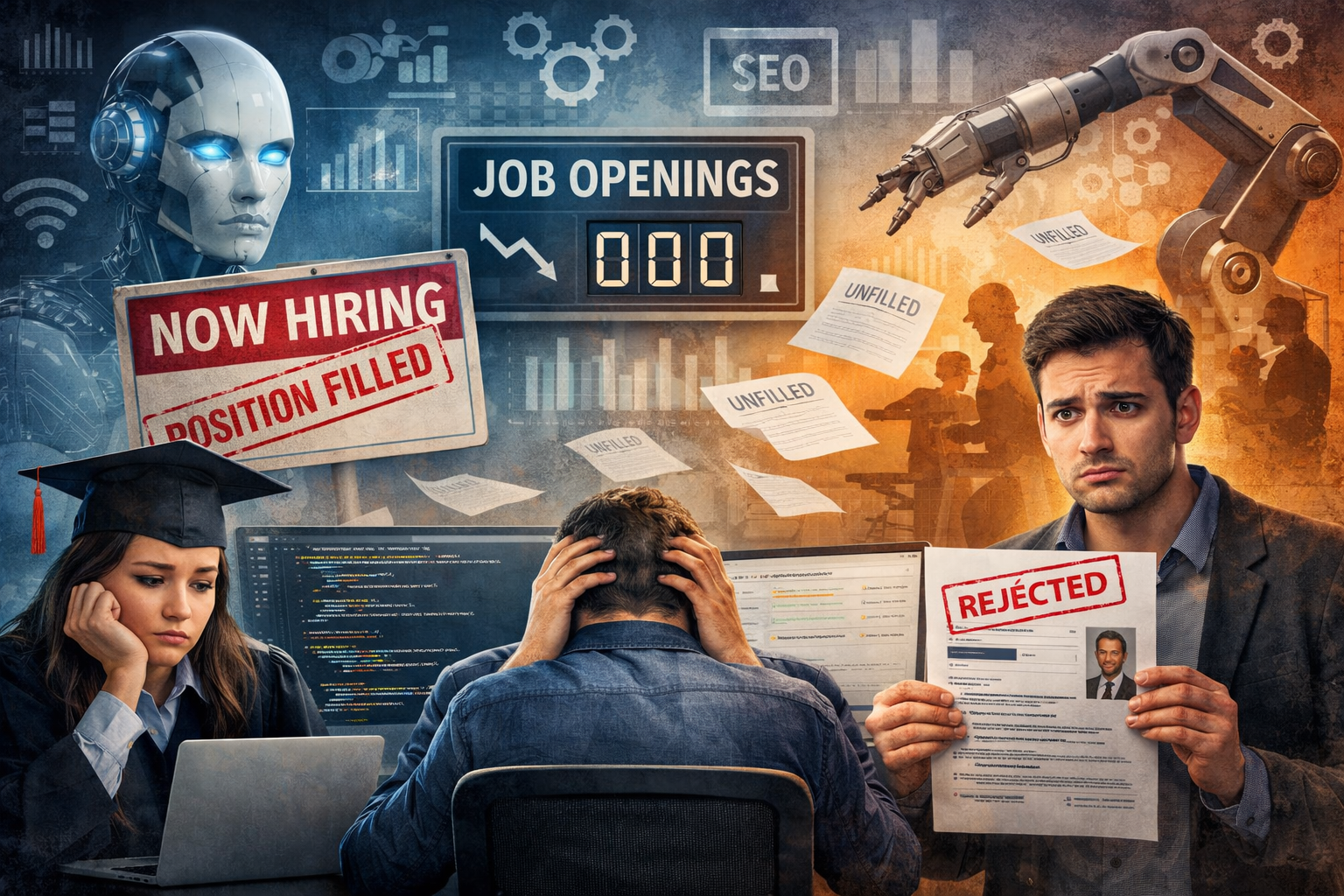
The modern job market feels fundamentally different, and for many, deeply frustrating. People with degrees, certifications, and years of experience are applying to hundreds of jobs without responses, while others with fewer qualifications appear to find work more easily. It creates a perception that the system is broken and that education and skill no longer matter. Who would have thought?
But what’s actually happening is more complex.
The job market hasn’t stopped valuing skill. Instead, it has redefined what “valuable” means, while simultaneously reducing opportunities, restructuring hiring processes, and shifting demand across industries. The result is a system that feels unpredictable, inefficient, and increasingly difficult to navigate.
To understand why this is happening, we need to examine the structural changes reshaping employment today, and more importantly, what can realistically be done to fix them.
A Slower Market With Fewer Opportunities
One of the biggest misconceptions about today’s job market is that jobs are abundant but inaccessible. In reality, there are fewer opportunities overall.
Hiring rates have slowed significantly in recent years, even while layoffs remain relatively moderate. This has created what economists describe as a “low-hire, low-fire” economy, companies are holding onto current employees but not expanding their workforce.
This leads to a bottleneck effect:
- Fewer new positions are created
- Workers stay in roles longer
- Advancement opportunities shrink
- Competition intensifies at every level
Even highly qualified candidates are now competing against hundreds of applicants for a single role. In this environment, rejection is less about capability and more about limited availability.
The Collapse of Entry-Level Opportunities
Perhaps the most damaging shift is the disappearance of true entry-level roles.
Many positions labeled “entry-level” now require years of experience. Companies have gradually moved away from training new employees, expecting candidates to arrive fully prepared. This creates a paradox:
You need experience to get a job, but you need a job to get experience.
As a result:
- New graduates struggle to enter their fields
- Career switchers face major barriers
- Skilled individuals are pushed into unrelated or lower-skilled roles
This contributes heavily to underemployment, where people work jobs far below their qualifications, not because they lack ability, but because the system no longer provides a clear entry point.
The Rise of AI and Automation
Artificial intelligence has rapidly transformed the labor market, especially in white-collar industries.
Unlike past technological shifts, AI does not just replace manual labor, it automates cognitive and technical tasks, including:
- Writing and content generation
- Coding and debugging
- Data analysis
- Customer support
This has two major effects:
- Reduced need for entry-level workers
Tasks that once trained junior employees are now automated. - Increased productivity expectations
Smaller teams can now produce more output, reducing hiring demand.
Instead of replacing entire jobs, AI is eliminating portions of jobs — especially those performed by beginners. This makes it significantly harder to enter industries that once relied on gradual skill development.
The Skills Mismatch Problem
Another major issue is not a lack of talent — but a mismatch between what people learn and what employers need.
Many degree programs emphasize theory over application, while employers prioritize:
- Hands-on experience
- Tool proficiency
- Problem-solving ability
- Immediate productivity
This disconnect means:
- Graduates feel unprepared
- Employers feel candidates lack practical skills
- Hiring slows due to perceived risk
Increasingly, companies are shifting toward skills-based hiring, where demonstrated ability matters more than formal education alone.
Algorithmic Hiring and Broken Systems
The hiring process itself has become a major barrier.
Most companies now rely on automated systems to screen resumes before a human ever reviews them.
These systems prioritize:
- Keywords
- Formatting
- Exact matches to job descriptions
As a result:
- Qualified candidates are filtered out
- Minor differences lead to rejection
- Applications feel like they disappear into a void
Additionally, many job listings are not what they seem. Some are outdated, inactive, or posted for internal or compliance reasons. This creates a situation where job seekers are applying to roles that may not even exist.
Oversupply of Educated Workers
Over time, more people have earned degrees, but the number of high-skill jobs has not increased at the same pace.
This creates a saturation effect:
- More candidates competing for fewer roles
- Reduced advantage of having a degree
- Increased expectations from employers
In some industries, particularly tech, this has led to a highly competitive environment where even strong candidates struggle to stand out.
Industry Imbalance: Where the Jobs Actually Are
Not all sectors are struggling equally.
Job growth is currently concentrated in areas like:
- Healthcare
- Education
- Service industries
Meanwhile, industries such as tech, finance, and corporate roles are experiencing:
- Slower hiring
- Increased automation
- Greater competition
This makes it appear that “less skilled” workers are being hired more easily, but in reality, demand has shifted, not disappeared.
Why I Couldn’t Leave My Field Out: What’s Happening in Tech
The technology sector, especially web development, artificial intelligence, and search engine optimization (SEO) offers one of the clearest examples of how dramatically the labor market has changed.
In recent years, the number of developers entering the field has grown rapidly. Coding bootcamps, online certifications, and global remote work have made tech more accessible than ever. However, this increased accessibility has also created oversupply, particularly at the entry level.
At the same time, demand has shifted. Companies are no longer hiring large numbers of specialized junior developers. Instead, they prefer full-stack engineers who can handle multiple responsibilities across systems. This consolidation reduces the number of available roles and raises the bar for entry.
Artificial intelligence has accelerated this trend. Tools that assist with coding, debugging, and documentation allow smaller teams to accomplish more. As a result, companies can maintain productivity while hiring fewer people, especially at junior levels.
In the SEO industry, the shift is just as significant. Traditional keyword-focused roles are being replaced by:
- Technical SEO
- Data analysis
- AI-assisted content strategies
Search engines have become more sophisticated, prioritizing context, quality, and user intent over simple keyword optimization. This has transformed SEO into a more technical and analytical discipline.
The result across all three areas, web development, AI, and SEO are the same:
- More people entering the field
- Fewer entry-level opportunities
- Higher expectations for each role
Employers now look for hybrid candidates who combine technical ability, AI literacy, and measurable business impact. This makes the field feel especially competitive , even for those with degrees and experience.
Should We Be Fixing the Job Market?
Yes! But not by trying to return to the past.
The job market is not simply broken — it is misaligned. Fixing it requires structural changes across multiple areas.
How the Job Market Can Be Fixed
1. Fix the Hiring Process
Companies need to reduce reliance on automated filtering and reintroduce human judgment earlier in hiring.
Key improvements:
- Limit excessive resume screening systems
- Ensure job postings reflect real, active roles
- Reduce unnecessary interview rounds
- Hire based on potential, not perfection
2. Rebuild Entry-Level Pathways
Without entry points, the system cannot sustain itself.
Solutions include:
- Paid apprenticeships and training programs
- True entry-level roles with mentorship
- Incentives for companies to invest in junior talent
3. Align Education With Industry Needs
Education must evolve alongside the labor market.
This means:
- Integrating real-world projects into curricula
- Emphasizing practical skills and tools
- Strengthening partnerships between schools and employers
4. Adapt to AI Instead of Competing With It
AI should be treated as a tool, not a threat.
Workers need:
- Training in AI collaboration
- Skills in oversight, strategy, and creativity
- Opportunities to transition into evolving roles
5. Address Oversupply in Saturated Fields
Better guidance is needed to help individuals make informed career decisions.
This includes:
- Clear labor market data
- Encouragement toward high-demand industries
- Cross-disciplinary skill development
6. Encourage Job Creation
Policies and incentives can encourage companies to expand hiring rather than minimize it.
Focus areas:
- Support for small businesses and startups
- Investment in innovation sectors
- Incentives tied to hiring and training
7. Improve Transparency
Job seekers need clearer, more accurate information.
This can be achieved through:
- Honest job postings
- Salary transparency
- Better communication during hiring processes
The Hard Truth
Even if these changes are implemented, one reality remains:
The job market is becoming more competitive by design.
Technology increases productivity. Globalization increases competition. Companies prioritize efficiency. These forces are not temporary, they are structural.
This means success will increasingly depend on:
- Adaptability
- Continuous learning
- Strategic positioning
A System in Transition
The frustration many people feel is real and justified. But it is not the result of randomness or failure at the individual level.
It is the result of a system that has changed faster than people and institutions have been able to adapt.
The modern job market rewards:
- Applied skills over credentials
- Flexibility over specialization
- Impact over experience alone
Understanding this shift is the first step toward navigating it.
The next step is rebuilding a system that aligns opportunity with capability, so that skill, effort, and education once again lead to meaningful work.
“It is not the strongest of the species that survive, nor the most intelligent, but the one most responsive to change.” — Charles Darwin
References posted here