Lesson Overview
Search engines help people find information online. When someone types a question, phrase, product, service, or topic into a search engine, the search engine looks through its stored information and shows results that it believes are the most helpful and relevant.
Search engines do not manually read every website. Instead, they use automated programs to discover, read, organize, and rank web pages.
What You Will Learn
In this lesson, you will learn the basic steps search engines use to find and organize web pages: crawling, indexing, and ranking.
The Three Main Steps
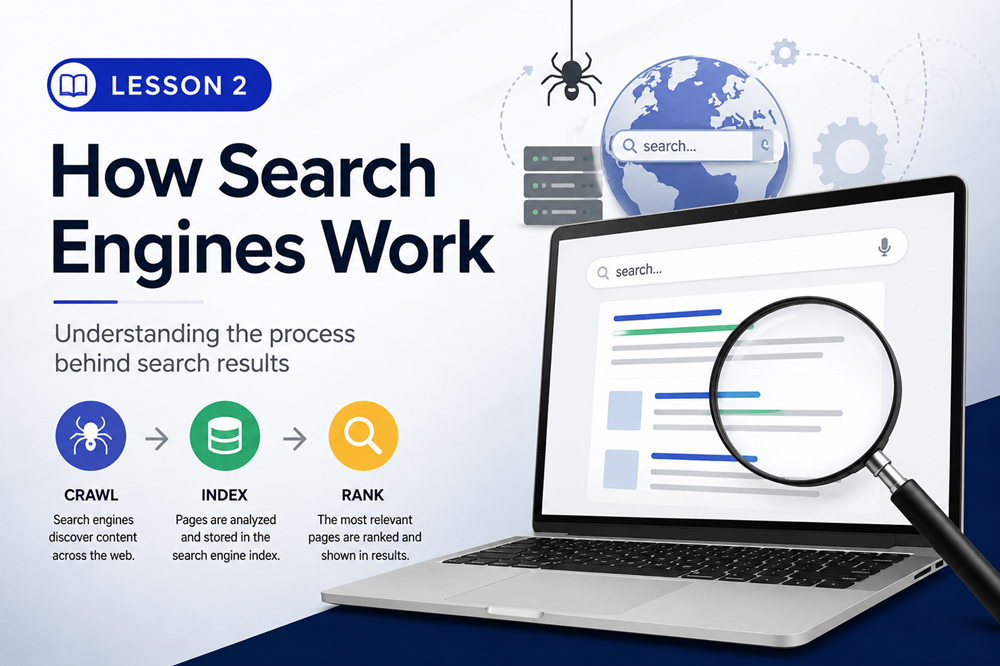
Search engines usually work through three main steps:
- Crawling: discovering pages on the internet
- Indexing: storing and organizing information from those pages
- Ranking: deciding which pages should appear first in search results
Step 1: Crawling
Crawling is the process search engines use to discover web pages. A search engine sends out automated programs called crawlers, bots, or spiders. These crawlers visit websites, read pages, and follow links from one page to another.
For example, if your homepage links to your services page, your about page, and your contact page, a crawler may follow those links to discover each page.
Example
If your website has a page called Computer Repair Services and that page is linked from your homepage, a search engine crawler may find it by following the homepage link.
Step 2: Indexing
After a search engine discovers a page, it tries to understand what the page is about. This process is called indexing.
During indexing, the search engine looks at information such as:
- The page title
- Headings
- Paragraph content
- Images and image descriptions
- Internal links
- The overall topic of the page
If the search engine understands the page and decides it is useful, the page may be stored in the search engine’s index. The index is like a huge library of web pages.
Step 3: Ranking
Ranking is the process of deciding which pages appear first, second, third, and so on in search results.
When someone searches for something, the search engine looks through its index and tries to show the best results for that search.
Search engines may consider many things when ranking pages, including:
- How relevant the page is to the search
- How helpful and clear the content is
- Whether the page loads quickly
- Whether the page works well on mobile devices
- Whether other trustworthy websites link to it
- Whether users are likely to find the page useful
Why Page Structure Matters
A well-structured page is easier for both people and search engines to understand. Clear headings, helpful paragraphs, descriptive links, and organized content all support better SEO.
If a page has no clear title, no headings, and confusing content, search engines may have a harder time understanding what the page is about.
Key Takeaway
Search engines work by discovering pages, organizing information, and ranking results based on relevance and usefulness. Your job with SEO is to make your pages clear, helpful, and easy to understand.
Lesson Quiz
Complete this short quiz to test your understanding of how search engines work.