
Lesson Overview
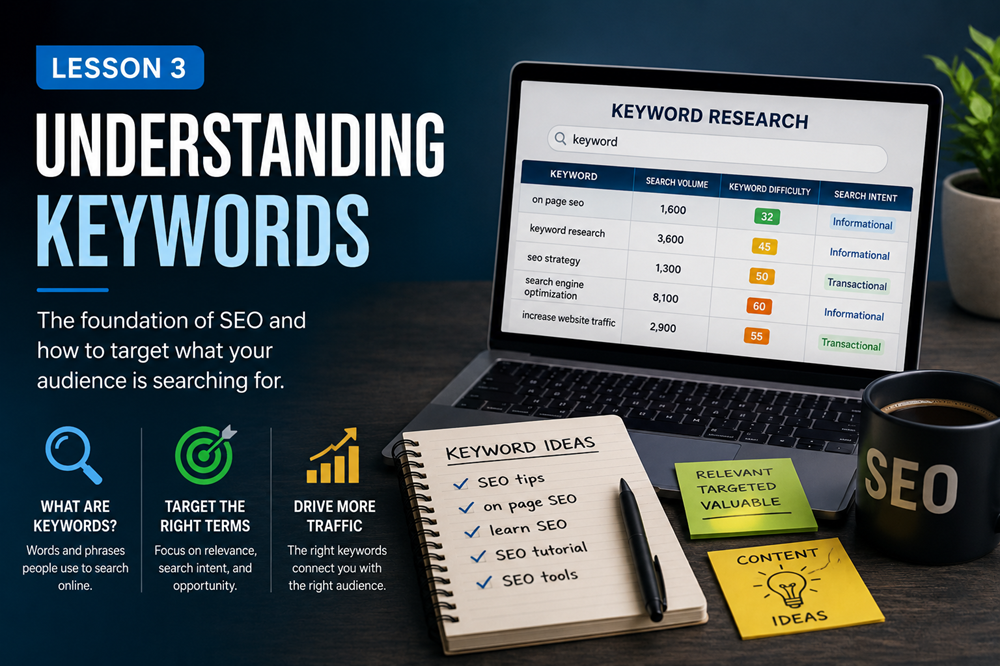
Keywords are the words and phrases people type into search engines when they are looking for information, products, services, or answers.
Understanding keywords is one of the most important parts of SEO because keywords help connect your website content with what people are searching for online.
What You Will Learn
In this lesson, you will learn what keywords are, why they matter, how to choose basic keywords, and how to use them naturally on a web page.
What Are Keywords?
A keyword is a search term or phrase that describes what a page is about. Keywords can be short, like SEO, or longer, like how to improve website SEO for beginners.
When someone searches online, the search engine tries to match that search with pages that are relevant and useful.
Example
If someone searches for computer repair near me, they are probably looking for a local computer repair business. A computer repair website should use clear, relevant wording that helps search engines understand that the business offers computer repair services.
Short Keywords vs. Long-Tail Keywords
There are different types of keywords. Two common types are short keywords and long-tail keywords.
Short Keywords
Short keywords are usually one or two words. They are broad and can have a lot of competition.
Examples of short keywords include:
- SEO
- web design
- computer repair
- marketing
Long-Tail Keywords
Long-tail keywords are longer and more specific phrases. They usually have less competition and can be easier to target, especially for beginners and small businesses.
Examples of long-tail keywords include:
- SEO tips for small business websites
- affordable computer repair in my area
- how to improve website ranking on Google
- best website maintenance services for small businesses
Why Keywords Matter
Keywords help search engines understand the topic of your page. They also help users quickly see whether your content matches what they are looking for.
Good keyword use can help your page:
- Appear for more relevant searches
- Attract visitors who are interested in your topic
- Make your content clearer and more organized
- Improve page titles, headings, and descriptions
- Support better on-page SEO
How to Choose Basic Keywords
When choosing keywords, think about what your audience would type into a search engine. Do not only think like the business owner. Think like the customer, student, client, or visitor.
Ask yourself:
- What problem is the visitor trying to solve?
- What service or product are they looking for?
- What question would they type into Google?
- Is the keyword related to the page content?
- Is the keyword specific enough to match the visitor’s intent?
Search Intent
Search intent means the reason behind a search. Understanding intent helps you choose the right keywords and write better content.
Common types of search intent include:
- Informational: The person wants to learn something.
- Local: The person is looking for something nearby.
- Commercial: The person is comparing options before buying.
- Transactional: The person is ready to take action, such as buying, booking, or contacting a business.
Example of Search Intent
The keyword what is SEO has informational intent because the person wants to learn. The keyword SEO services near me has local or commercial intent because the person may be looking for a business that offers SEO services.
Where to Use Keywords
Once you choose a keyword, use it naturally in important areas of the page. Do not force it into every sentence.
Good places to use keywords include:
- Page title
- Main heading
- Subheadings
- First paragraph
- Image alt text when relevant
- Meta description
- Internal links
Avoid Keyword Stuffing
Keyword stuffing means repeating a keyword too many times in an unnatural way. This makes content harder to read and can hurt the quality of the page.
Instead of repeating the same phrase over and over, write naturally and use related words when appropriate.
Better Approach
Use keywords to guide your content, but write for people first. Clear, helpful content is better than content that repeats the same keyword too many times.
Simple Keyword Example
Imagine you are creating a page for a computer repair business. A broad keyword might be:
- computer repair
A better long-tail keyword might be:
- computer repair services for small businesses
This longer keyword is more specific and tells both users and search engines what the page is about.
Key Takeaway
Keywords help connect your content with what people are searching for. Choose keywords that match your page, your audience, and the user’s search intent. Use them naturally and focus on creating helpful content.
Lesson Quiz
Complete this short quiz to test your understanding of SEO keywords.