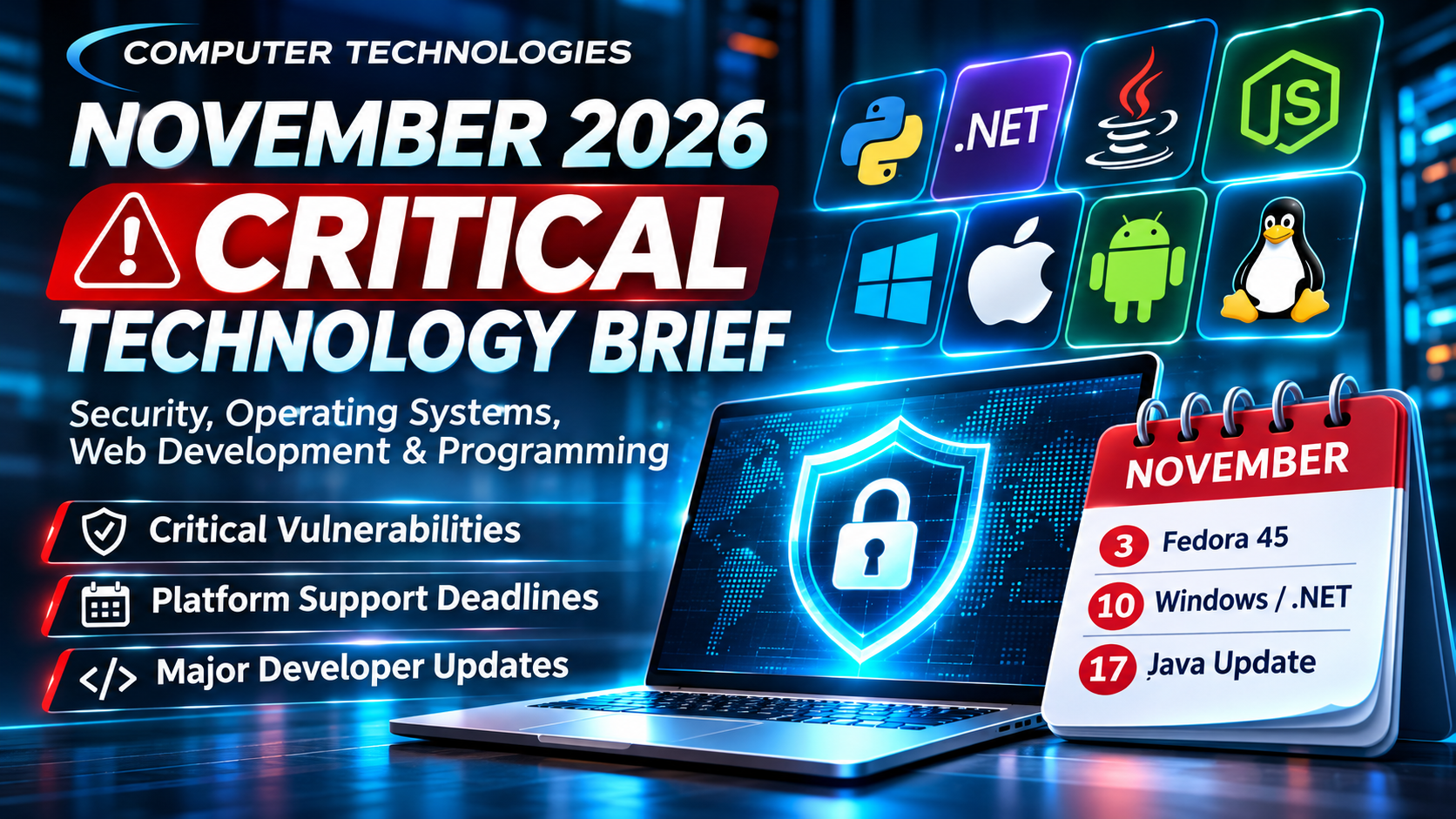
Critical Technology Brief Security. Systems. Development.
November opens with critical remote-code-execution vulnerabilities, operating-system support deadlines, browser and runtime security updates, major Linux changes and another important shift in the way developers build and secure modern applications.
What IT professionals and developers need to know this month
November 2026 is shaping up primarily as a security and platform-transition month. The most important developments affect servers, development infrastructure, mobile devices, operating systems, browsers, programming runtimes and the certificate infrastructure behind HTTPS.
PHP2Shell: PHP Servers Require Immediate Attention
Two vulnerabilities collectively known as PHP2Shell represent one of the most serious web-server threats entering November.
The vulnerabilities can allow unauthenticated remote-code execution against vulnerable PHP installations.
Affected environments can include:
- PHP-FPM
- Apache with mod_php
- php-cgi
- FrankenPHP
- LiteSpeed environments
Patched releases include PHP 8.5.12, 8.4.27, 8.3.36 and 8.2.35.
This is not specific to WordPress or another CMS. Custom PHP applications, APIs, business portals and internal web systems can also be exposed.
GitLab CVSS 10 Remote-Code Execution
Self-managed GitLab installations require immediate attention because of CVE-2026-97229, a maximum-severity CVSS 10.0 vulnerability.
An unauthenticated attacker may be able to execute arbitrary code on a vulnerable GitLab server through specially crafted CI/CD configuration processing.
Affected branches include versions prior to:
- GitLab 19.2.8
- GitLab 19.3.5
- GitLab 19.4.2
CI/CD infrastructure can contain source code, deployment credentials, secrets, API keys, containers, build artifacts and access to production systems.
November Android Update Includes Critical Zero-Interaction RCE
Google’s November Android Security Bulletin contains a critical Framework vulnerability identified as CVE-2026-58868.
The flaw may lead to remote-code execution without additional privileges and without requiring user interaction.
Supported Android versions including Android 14, 15, 16 and 17 are affected.
Devices should ultimately report an Android Security Patch Level of 2026-11-05 or later.
Windows: November 10 Is an Important Deadline
Windows 11 23H2 Enterprise and Education reach end of servicing on November 10, 2026.
Windows 11 24H2 Home and Pro already reached the end of their normal servicing lifecycle in October.
Administrators should inventory systems still using:
- Windows 11 23H2 Enterprise/Education
- Windows 11 24H2 Home/Pro
Microsoft’s November Patch Tuesday also falls on November 10.
Microsoft continues tightening older NTLM-based authentication, which can expose compatibility problems in legacy Wi-Fi, VPN, Ethernet and enterprise authentication configurations.
macOS: Apple Silicon Is Now the Platform
macOS 27 Golden Gate represents another major stage in Apple’s hardware transition.
macOS 27 supports Apple Silicon Macs rather than Intel Macs.
Apple has identified macOS 27 as the final major release providing general-purpose Rosetta support for normal Intel-only applications.
Developers should audit:
- Intel-only executables
- native libraries
- installer scripts
- audio and video plug-ins
- command-line utilities
- legacy frameworks
Apple Silicon support is becoming a deployment requirement rather than merely a performance optimization.
iOS, iPadOS and macOS 27.2 Raise the Security Baseline
Apple’s 27.2 platform updates address vulnerabilities involving WebKit, kernel memory, permissions, sandboxing, certificate validation and other operating-system components.
Multiple WebKit fixes are particularly relevant because malicious web content can become an entry point into an operating system even when a user never deliberately installs software.
Mac, iPhone and iPad users should treat these releases as security updates first, rather than simply feature upgrades.
Fedora Linux 45 Arrives November 3
Fedora Linux 45 passed its final Go/No-Go decision and enters November as one of the month’s significant Linux releases.
Major changes include:
- mandatory package-signature validation
- newer console infrastructure
- Podman 6
- Python 3.15
- Go 1.27
- GCC 16.2
- glibc 2.44
Package-signature enforcement is particularly important as Linux distributions strengthen the software supply chain and prevent accidental installation of untrusted packages.
Linux Kernel Security Still Matters Beneath Containers
Recent Linux vulnerabilities continue reinforcing an important infrastructure lesson.
Keeping Docker, Kubernetes or Podman current does not compensate for an unpatched Linux kernel.
Kernel vulnerabilities capable of privilege escalation or container escape should remain part of normal infrastructure patching.
Chrome and Firefox Remain High-Priority Patch Targets
Modern browsers process far more than HTML and CSS.
- JavaScript
- WebAssembly
- WebGPU
- media codecs
- PDF documents
- authentication flows
- password-management interfaces
- local-device APIs
That makes browser vulnerabilities increasingly similar to operating-system vulnerabilities in terms of exposure.
Firefox 159 is current entering November and includes multiple high-severity security corrections. Chrome installations should also be checked following Google’s unusually large October security releases.
Browser DevTools Are Becoming Agent-Aware
One of November’s most interesting development trends is occurring directly inside browser tooling.
Chrome DevTools can increasingly expose runtime information to coding agents, including:
- matched CSS styles
- inherited styles
- pseudo-elements
- keyframes
- CSS at-rules
- performance traces
Coding agents are beginning to interact with the DOM, computed CSS, browser diagnostics and runtime performance data—not simply source files.
Node.js 26 Is Now LTS
Node.js 26 officially transitioned into Long-Term Support under the codename Lithium.
The 26.x branch is scheduled to receive updates through April 2029.
Migration testing should include:
- native modules
- npm dependencies
- Linux binaries
- CI environments
- containers
- serverless runtimes
Python 3.15 Is Here — But Patch the Runtime
Python 3.15 introduced several significant changes, including explicit lazy imports, frozendict , a built-in sentinel type, UTF-8 as the default encoding and continued JIT development.
Developers should nevertheless avoid remaining on the original 3.15.0 build.
Expedited security releases include:
- Python 3.15.2
- Python 3.14.10
- Python 3.13.18
- Python 3.12.16
- Python 3.11.18
Those releases also respond to changes involving compromised certificate-authority trust.
November 10 Is a Major .NET Deadline
The Microsoft development ecosystem reaches an important transition point on November 10.
.NET 8 and .NET 9 reach end of support.
At the same time, .NET 11 launches during .NET Conf, November 10–12.
The new generation includes developments across:
- C# 15
- ASP.NET Core
- Blazor
- Entity Framework Core
- .NET MAUI
- runtime and SDK tooling
Existing production .NET environments should receive current security updates now rather than waiting for .NET 11.
Java Security Updates Are Accelerating
Oracle’s next Java Critical Security Patch Update is scheduled for November 17, 2026.
The Java ecosystem is moving toward more frequent security releases rather than depending exclusively on traditional quarterly update cycles.
Organizations bundling JDKs or JREs inside applications may therefore need faster:
- build cycles
- testing cycles
- container rebuilds
- application releases
- production deployments
The eMudhra Compromise Is a Cross-Platform Security Lesson
The compromise of private keys belonging to multiple eMudhra intermediate certificate authorities triggered trust-store changes across multiple technology ecosystems.
Responses have involved:
- Apple
- Firefox
- Python
- Java
- Ubuntu
- Node.js
HTTPS security depends on the trust infrastructure of the entire software ecosystem—not simply the SSL/TLS certificate installed on a web server.
Critical November Dates
| Date | Technology Event | Priority |
|---|---|---|
| November 2 | Android November Security Bulletin | Critical |
| November 3 | Fedora Linux 45 | Developer / Linux |
| November 10 | Windows Patch Tuesday | High |
| November 10 | Windows 11 23H2 Enterprise/Education end of servicing | Critical |
| November 10 | .NET 8 and .NET 9 end of support | High |
| November 10–12 | .NET Conf and .NET 11 | Developer |
| November 17 | Oracle Java Critical Security Patch Update | High |
The Bottom Line
November 2026 should primarily be viewed as a security and platform-transition month.
PHP servers face critical unauthenticated remote-code-execution vulnerabilities. Self-managed GitLab installations face a maximum-severity RCE issue. Android’s November bulletin contains a critical vulnerability requiring no user interaction. Windows is reaching another lifecycle deadline, Apple is closing the Intel era, and programming runtimes are moving toward faster security cycles.
At the same time, web development itself is changing. Browser development tools are becoming accessible to coding agents, Linux distributions are strengthening software trust, and developers increasingly need to think beyond application code when evaluating security.
Research behind this November Tech Brief
This brief was compiled from official security advisories, operating-system release documentation and developer-platform announcements. Use the sources below to review the original technical information.
Not sure which updates affect your technology?
Computer Technologies can review your devices, websites and digital systems and turn the findings into a practical, prioritized action plan.