The problem is not that people use AI. The problem is that too many people publish it without thinking. There are two articles, one written entirely by AI and one written by a Human.
First is Article A: The AI-Written Version
Can We Tell the Difference Between AI and Human Content?
Artificial intelligence is changing the way people create and consume information. Tools such as ChatGPT, Gemini, Grok, and other generative AI systems can now produce articles, images, videos, social media captions, emails, music, and even realistic human voices. As this technology becomes more advanced, many people are asking an important question: how can we tell whether content was created by a human or generated by AI?
At first, people believed AI-generated content was easy to identify. AI images often had distorted hands, strange faces, unreadable text, or unrealistic backgrounds. AI-written content often sounded repetitive, overly formal, or generic. However, modern AI systems have improved quickly. Many of the old signs are no longer reliable.
This creates a challenge for everyday users. People are now expected to judge whether a photo, video, article, review, or social media post is real, even when the content may have been created or altered by AI. The problem is that human judgment alone is often not enough. AI-generated content can appear natural, emotional, persuasive, and realistic.
There are several ways people can evaluate content more carefully. First, they should consider the source. Content from an unknown account, anonymous page, or reposted screenshot should be treated with more caution than content from a verified or trusted source. Second, people should look for context. If an image or video shows a major event, there should usually be other credible reports confirming it. Third, people can use reverse image search or fact-checking tools to see whether the content appears elsewhere online.
Technical solutions are also being developed. Some companies use watermarking to identify AI-generated content. Others use provenance systems that attach information about where a piece of media came from and how it was edited. These tools may help users understand whether content was created by AI, edited by AI, or captured by a real device.
However, no system is perfect. Metadata can be removed. Watermarks may not appear across every platform. AI detectors can make mistakes. This means people should not depend on one clue or one tool. Instead, they should use a combination of source-checking, context, technical verification, and critical thinking.
The future of digital trust will depend on more than identifying whether something was made by AI. It will depend on whether people are willing to verify information before believing it or sharing it. AI is not automatically harmful, but using AI without transparency can mislead audiences.
In the end, the most important question may not be, “Was this created by AI?” The better question may be, “Can I verify where this came from, and can I trust the person or platform sharing it?”
Second is Article B: The Human-Written Version
I Asked AI to Write About AI. Then I Had to Ask Myself What Was Missing.
Lately, it feels like everyone is trying to become an AI detective. Pinpointing flaws with an AI created image, wording, video, etc.
People are zooming in on fingers. They are checking shadows. They are looking at teeth, eyes, backgrounds, captions, punctuation, and whether a sentence sounds “too perfect.” We have reached a point where people are not only asking, “Is this true?” They are asking, “Did a person even make this?”
We are no longer dealing with simple spelling mistakes or bad Photoshop edits. AI can now write articles, create images, generate videos, imitate voices, summarize research, write captions, answer customer questions, and produce content faster than most people can review it. The issue is not that AI exists. The issue is that AI content can now move through the internet without people knowing where it came from, who checked it, or whether anyone took responsibility for it.
That is where the real problem begins.
For a while, people were told to look for obvious signs. Bad hands. Strange lighting. Robotic writing. Repeated phrases. Generic introductions. But those clues are becoming weaker. AI is improving, and humans are not always as good at spotting it as they think they are.
If a person cannot reliably tell whether an image, video, or article was made by AI, then the burden cannot be placed only on the viewer. We need better habits, better labeling, better platform standards, and better honesty from the people using these tools.
But we also need to talk about something uncomfortable: some people are using AI lazily.
They are copying, pasting, posting, and publishing without adding judgment. They are allowing AI to sound informed without checking whether it is accurate. They are letting AI speak in a voice that sounds polished but has no lived experience behind it. That is not innovation. That is lowering the standard.
Using AI is not the problem. Refusing to think after using AI is the problem.
A responsible person can use AI to brainstorm, organize, edit, summarize, or research. But before that content is published, a human should ask: Is this true? Is this useful? Is this fair? Does this sound like me? Did I verify the claims? Would I stand behind this if someone challenged it?
That last question matters most.
Because the future of content should not be a war between humans and AI. It should be a standard. If AI helped create something, say so when it matters. If the content makes a factual claim, verify it. If the writing sounds empty, add human insight. If the article has no original thought, do not pretend it does. Why say something, just to say it. I think that’s the biggest catch is when AI says something that has no meaning.
Maybe the question should not only be, “Can we tell if AI made this?”
Maybe the better question is, “Did a human care enough to make it trustworthy?”
AI can create content. But humans still have to create meaning behind it. Don’t let AI create it and then leave it, make it matter, make it say what you mean.
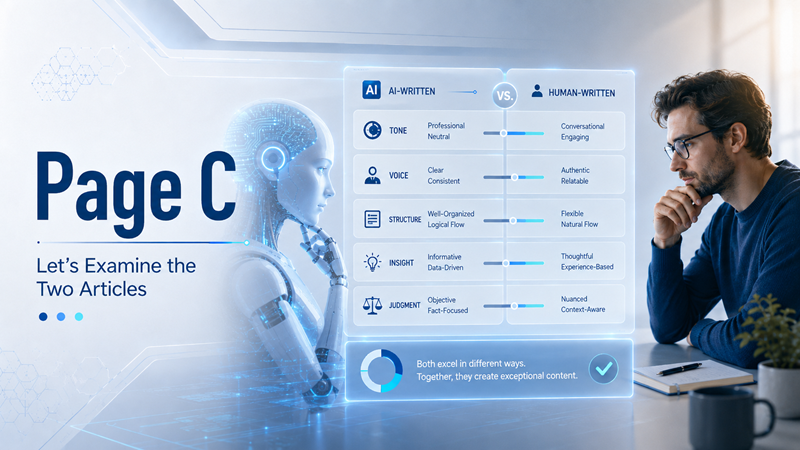
Page C: Now, let’s Examine the Two Articles
Before reading this section, ask yourself which article sounded more human.
Article A is polished. It is organized. It explains the issue clearly. It uses balanced language and gives practical advice. Nothing about it is necessarily wrong. That is what makes AI-generated writing difficult to identify. It can be useful, readable, and accurate enough to sound trustworthy.
But Article A also has signs of common AI-style writing. It opens broadly. It explains the topic in a neutral tone. It moves through the issue in a predictable order. It does not include a personal observation, a strong opinion, a lived example, or a unique author perspective. It sounds like information, but not necessarily like a person thinking through a problem in real time.
Article B covers the same subject, but it feels different. It starts with a human observation: people zooming in on fingers, shadows, teeth, and captions. It has a clearer point of view. It does not only explain that AI content exists. It questions how people are using it. It challenges lazy publishing. It asks whether a human took responsibility for the final work.
AI writing often summarizes. Human writing often interprets.
That is the difference readers should notice.
AI writing often organizes. Human writing often argues.
AI writing often sounds smooth. Human writing often carries concern, judgment, memory, frustration, curiosity, or responsibility.
This does not mean AI writing is useless. It means raw AI output should not be treated as finished human thought. AI can help create a draft, but a human should still verify the facts, add context, question the claims, and decide whether the final message deserves to be published.
The higher standard is not “never use AI.”
The higher standard is this: do not use AI as a replacement for thinking.
If AI helped, be honest when honesty matters. If the content makes claims, check them. If the writing sounds generic, improve it. If there is no human judgment in the final version, then the problem is not only the technology. The problem is the person who published it without careful consideration.
References
- Pavão, Adrien. “We Are Not Able to Identify AI-Generated Images.” arXiv, 2025.
This study found that people struggled to reliably distinguish real images from AI-generated images, with average accuracy only slightly above random guessing. - Milička, Jiří, Anna Marklová, Ondřej Drobil, and Eva Pospíšilová. “Humans Can Learn to Detect AI-Generated Texts, or at Least Learn When They Can’t.” arXiv, 2025.
This study found that people can improve at detecting AI-written text when they receive immediate feedback, but without training they are often confidently wrong. - “As Good as a Coin Toss: Human Detection of AI-Generated Content.” Communications of the ACM, 2025.
This research examined human ability to identify synthetic versus authentic images, audio, video, and audiovisual media. - Cheng, A. “Ability of AI Detection Tools and Humans to Accurately Identify AI-Generated Content.” National Library of Medicine / PMC, 2025.
This article discusses the limits of AI detection tools and notes that detector accuracy depends on factors such as the model used, text length, and how much human editing was done. - OpenAI. “New AI Classifier for Indicating AI-Written Text.” OpenAI, 2023.
OpenAI later discontinued this classifier because of its low accuracy, which supports the argument that simple AI text detectors should not be treated as final proof. - Coalition for Content Provenance and Authenticity. “C2PA: Verifying Media Content Sources.”
C2PA provides an open technical standard for showing the origin and edit history of digital content. - Content Credentials. “Verify Media Authenticity.”
Content Credentials explains how provenance labels can help users see information about where digital media came from and how it may have been changed. - Content Authenticity Initiative. “How It Works.”
This source explains Content Credentials as a type of “nutrition label” for digital content, showing information such as who produced it, when, and what tools or edits were used. - Google DeepMind. “SynthID.”
SynthID is Google DeepMind’s watermarking technology that embeds imperceptible signals into AI-generated images, audio, text, and video. - OpenAI. “Advancing Content Provenance for a Safer, More Transparent Digital Future.” OpenAI, 2026.
OpenAI describes its work with Content Credentials, SynthID, and public verification tools to help people understand the origin of AI-generated content. - Golaszewski, Enis, et al. “Verifying Provenance of Digital Media: Why the C2PA Specifications Fall Short.” arXiv, 2026.
This paper is useful for balance because it argues that provenance systems such as C2PA are promising but should not yet be relied on alone for high-stakes uses such as journalism, finance, or legal evidence. - Android Central. “Gemini Can Now Tell You Whether a Video Was Generated with Google AI.” 2026.
This is useful for explaining that Gemini can identify certain Google-generated AI videos through SynthID watermarking, but that such tools are limited to supported systems.